

In the AI industry, it’s important that we maximize bleeding-edge-FOMO by introducing a new core interaction paradigm every year. Last year, it was direct agent use. This year, it’s agentic orchestration.
This makes sense – last year, agents still needed so much oversight that you probably wanted to watch them pretty closely while they ran. Now, they’re increasingly autonomous over progressively longer time horizons. The human intervention required is more about answering key questions, providing high-level guidance, or verifying final work. So we’re seeing a new wave of nascent interaction patterns for this.
For my use cases, I’m looking for something to help me answer questions like:
Which agent is working on PR #123?
Which agent needs input from me / who is blocked?
Which open threads do I have going right now?
Which dependencies do I have between my open threads, if any?
High level sniff test: which agents are on the right track vs. spinning on a bad path?
Simplest option: Claude Agent View
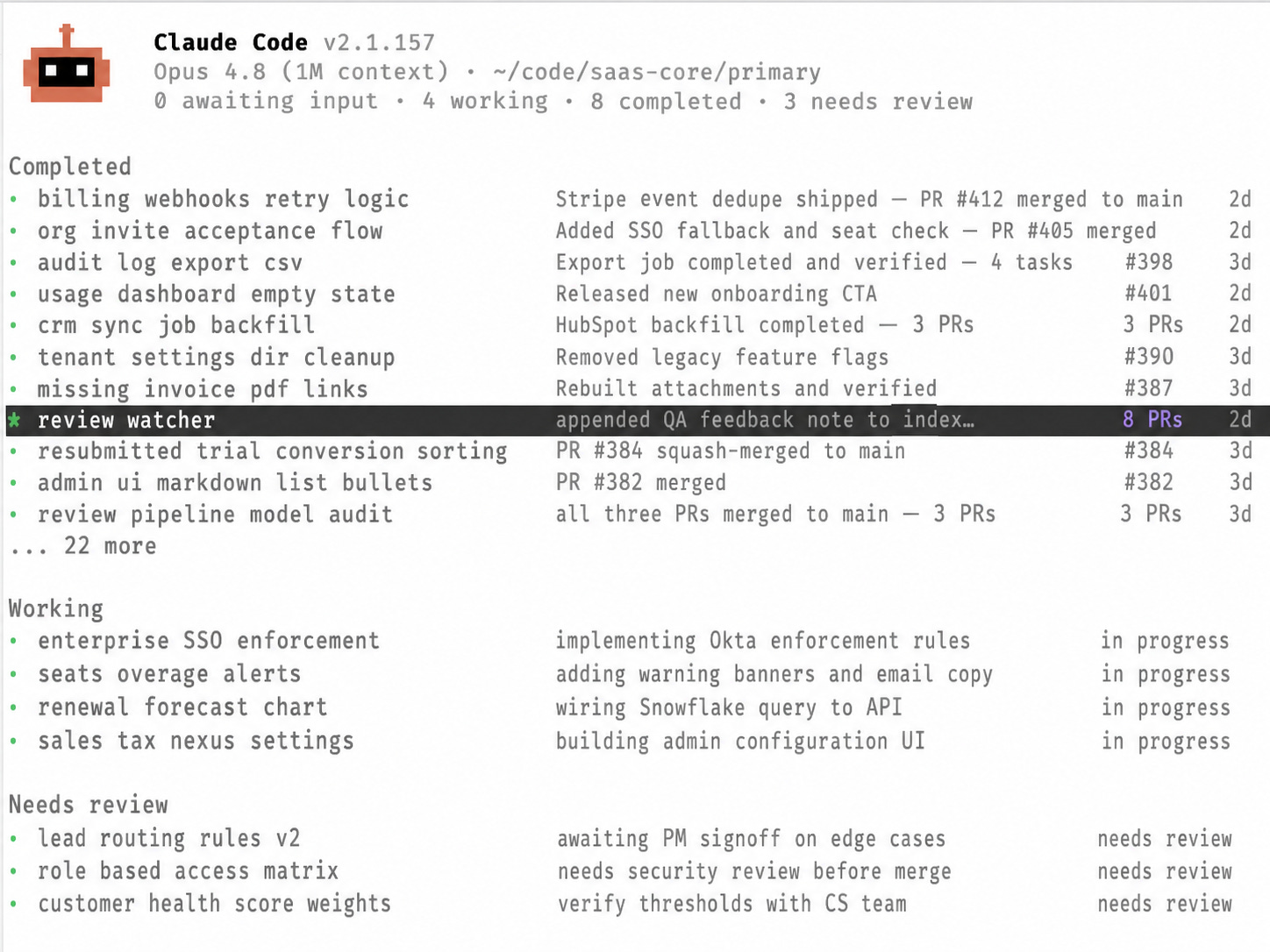
Invoke this from the command line by just running claude agents. This gives you a few neat things off the bat:
Agents live in the background, so you can close the terminal process without killing them
And maybe they survive a machine restart?
An overview of who is working on what, who needs your attention, etc
Low friction ability to spin up and delete worktrees
Things that aren’t great now but I imagine will improve quickly:
The logic that classifies sessions into categories (“needs review” vs “completed”) is buggy
The recaps are often not actually helpful
There’s no “archive” for old sessions – all you can do is hard delete
It’s too hard to tell which agents are working on which PRs when you have more than one PR per agent
Combined with Dynamic Workflows (“Ultracode”), you can easily orchestrate thousands of agents cranking through individually simple tasks.
OpenAI Symphony
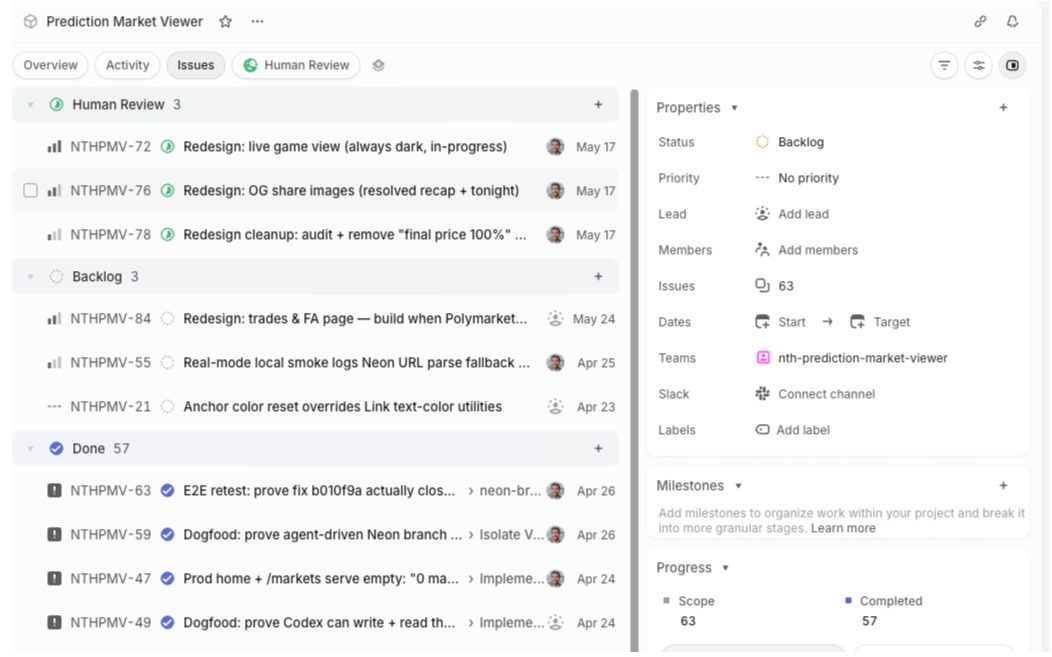
Symphony is one of several entrants in the “agent orchestration via kanban board” paradigm. It makes it easy to define rigorous workflows for task scoping, implementation, QA, security review, etc. The whole thing is a state machine of human and agent steps, and it’s easy for you to customize.
Its creator described on Latent Space how he uses Symphony to tokenmax: Extreme Harness Engineering for Token Billionaires: 1M LOC, 1B toks/day, 0% human code, 0% human review — Ryan Lopopolo, OpenAI Frontier & Symphony.
With Claude Agent View, you still have to manage git state – so if a PR lands that you need other agents to know about, you gotta tell them, and/or they’ll get confused.
With Symphony, there’s a defined workflow to pull in the latest changes from main. When a change lands on main, that state transition fires for all work currently in progress.
With Linear + Vercel + GH, you have a pretty sweet “product development from your phone” setup:
File a ticket in Linear
Symphony picks it up, hands it to a worker
When it’s ready for you to review, it’ll appear in the Human Review phase in Linear
With the Vercel preview deployment, you can test the app on your phone
With the GH mobile app, you can quickly scan the source code
You move the ticket to the “accepted” status
The “merge to main + final QA” workflow runs
Agents for all the other in-flight PRs pull in these changes and do any merge updates required
This works well when the tasks are things that the agents will reliably do well at with minimal oversight. Symphony is a maximalist “you’re not a pair programmer; you’re a manager” approach.
But when the agent needs more direct supervision, the overhead of Symphony is a net loss – you’re doling out that supervision in 90 second bursts via comments on the Linear ticket, when what you really need is to be giving it very specific paired guidance.
For instance, I was trying to implement “drag on the x axis to set view range” functionality similar to what DataDog has. This is a classic weak point for agents, because they don’t have the ability to reliably use Playwright to validate their implementations here. So they just guess, and you tell them “nope that wasn’t it”, and then the 35 minute cycle turns again.
And it’s not just UI-polish tasks that the agent has a poor ability to self-correct on. More broadly, there are some heavy tasks where the agents aren’t very good right now without close supervision. Or even if they are decent some of the time, you feel like you need to dig into the agent’s work in the full editor experience vs. “I’m just approving this PR from GH”. In those cases, you’re better off using an agent in pair-programmer mode.
My rule of thumb right now is: if the task is something I could plausibly approve from my phone, then Symphony is a decent choice. If not, I’m sticking with claude agents.
So whether Symphony is right for you depends on what type of tasks you have – and I expect that over time, as agents get stronger, a Symphony-style approach will become more right for more people.
Of course, I often wouldn’t use Linear directly – I would drive via a separate agent with the Linear MCP. (“Decompose this spec into tickets”; “we’re not going to do the XYZ feature – close all tickets related to that, and descope tangentially related tickets to no longer mention it.”)
Another entrant in this category: Github Agentic Collaboration Environment (x post).
Conductor: solves the wrong problem
… for me, at least.
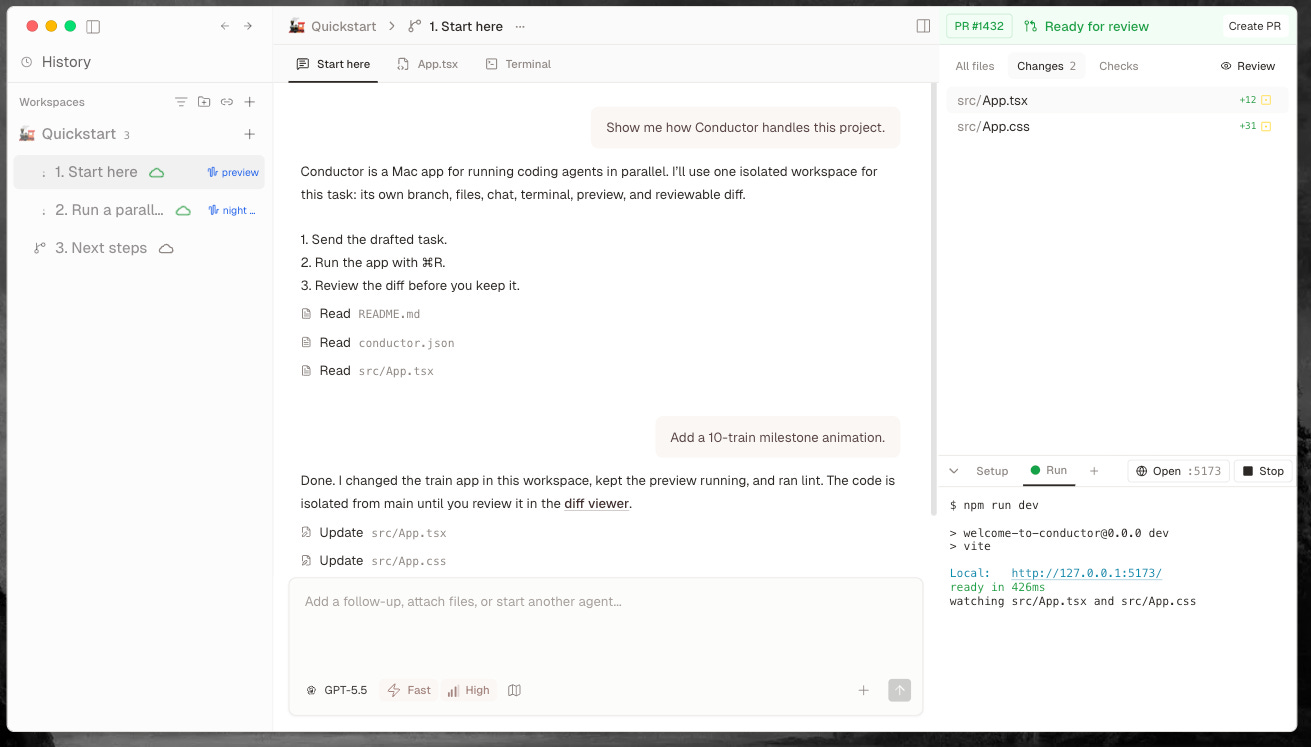
Conductor focused on helping you with the “spin up a worktree” / run in isolation / merge PRs aspects. To me, that’s not really the interesting part. For one thing, Claude Agent View basically does that for you, but also, it’s something you can set up for yourself without too much difficulty with Skills.
The bigger piece for me is the mass orchestration of “what is everyone doing and who needs my help”, which isn’t Conductor’s focus.
And beyond that: Conductor wraps Codex and Claude Code. Fundamentally, I don’t want a wrapper: there will always be a feature lag from / fidelity gap with the native experience. And I personally am fine using a TUI. So it’s just variation without value.
Honorable Mention: Elgato
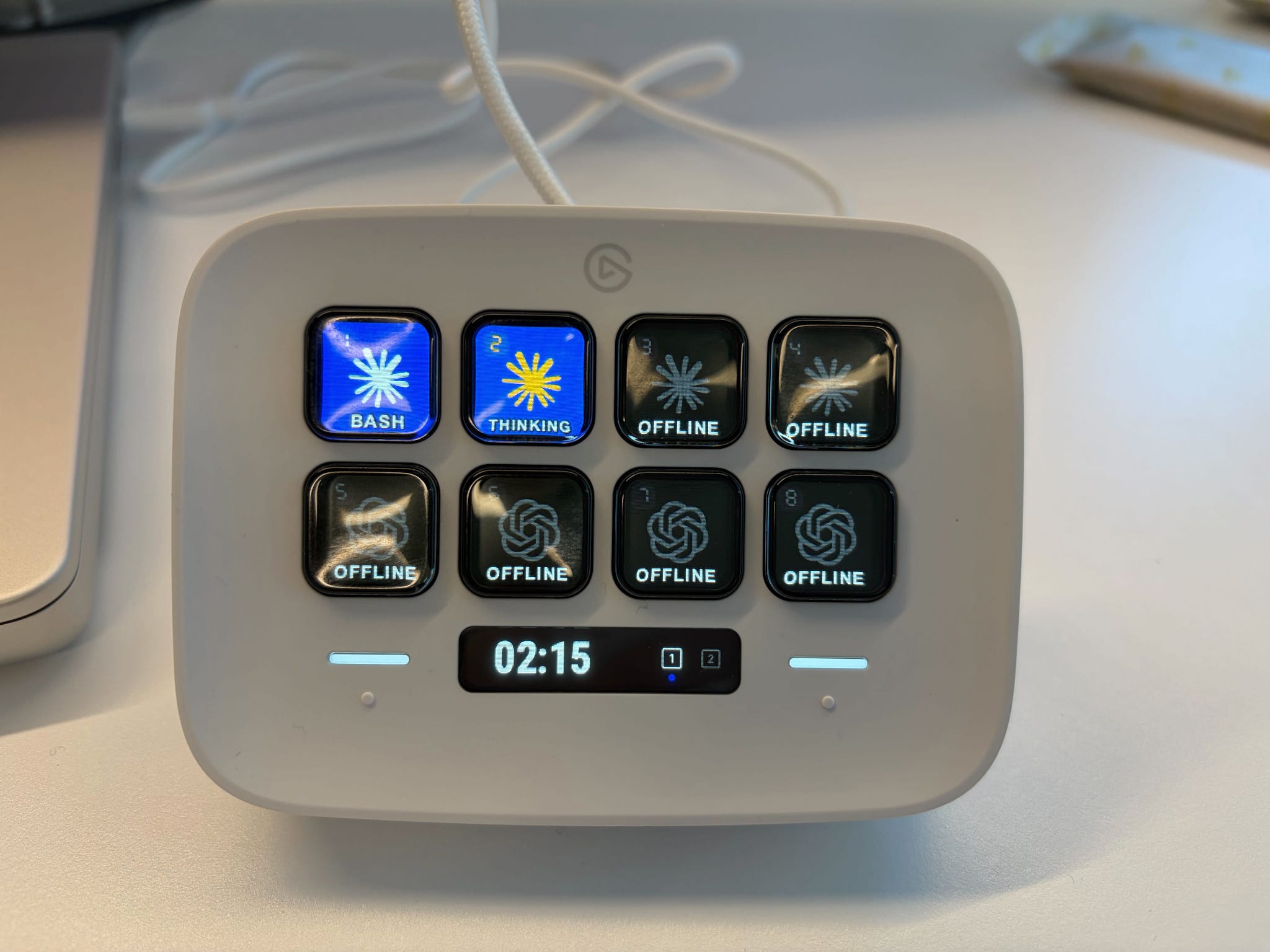
One of my colleagues bought an Elgato Stream Deck, then created a plugin that gives him hardware buttons to see which agents need attention. When he presses the button for an agent, it focuses the terminal to that tab.
What am I personally doing?
For the types of problems I’m working on today, Claude Agent View is my main driver.
I’ve batted around the idea of creating my own lightweight agent orchestrator, but every other time I’ve thought something along those lines, the correct move has been “just wait a few weeks and you’ll get 80% of what you’re looking for in an official product release”.